CNC Stainless Steel Machining Services From McCormick Industries
Expert people drive robotics manufacturing technologies through 3d printing prototype assembly using selective laser sintering, polyjet, cnc lathe machining, and milling. Machine shops try rapid manufacturing with steel alloys, stainless steel, nickel, teflon, nylon, polypropylene metal fabrication resistant to corrosion. Machined parts require hogge precision tolerances per technical specifications definition. Aviation, pharmaceutical, consumer electronics industries question machinability, surface finishing accuracy including powder coat, electroless nickel plating, chem film spray. Mccormick industries cnc machine shop studies case trends, career orders, tariffs affecting smt electronics ability. Customer rfq frequently asked questions guide cnc prototyping rights. States vapor deposition design creativity rest upon selective laser steel fabrication galon case studies quote.
Why Choose Precision Stainless Steel Machining Services
Selecting the right supplier for stainless steel machining services is a critical decision for engineers working in aerospace, defense, and medical manufacturing. Stainless steel alloys offer exceptional strength, hardness, and corrosion resistance, but these same properties make machining stainless steel more demanding than working with aluminum or mild steel. The work-hardening tendency of austenitic grades means that incorrect speeds and feeds can produce a hardened surface layer that accelerates tool wear and compromises dimensional accuracy. Precision stainless steel machining services from an experienced CNC shop mitigate these risks through proven toolpath strategies, rigid workholding, and rigorous in-process inspection.
Every project submitted to our facility benefits from a design-for-manufacturability review. Our engineers evaluate material selection, feature geometry, and tolerance stack-ups before the first tool engages. This front-end investment reduces cycle times, minimizes material waste, and ensures that finished components meet their form, fit, and function requirements on the first pass.
CNC Stainless Steel Machining Services — Equipment and Process
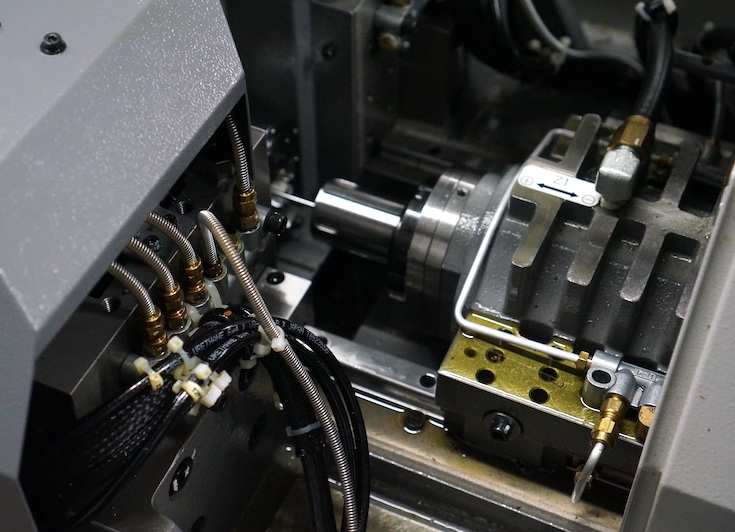
Our CNC stainless steel machining services are supported by a multi-machine environment that includes 3-, 4-, and 5-axis machining centers alongside multi-turret turning cells. Five-axis capability is essential for complex stainless steel parts that require compound angle features, undercuts, and intersecting bores that cannot be completed in a single setup on a conventional 3-axis machine. Reducing setups is especially important when machining stainless steel because each re-fixture introduces positional error and exposes the part to additional handling-related scratches.
Turning centers with live tooling allow us to complete turned-and-milled stainless steel parts in a single setup. This approach is common for medical fasteners, hydraulic fittings, and valve bodies where concentricity between turned and milled features must be maintained within a few tenths of a thousandth of an inch. Our stainless steel machining team runs these operations at optimized cutting parameters developed through material-specific testing rather than catalog defaults.
All CNC programs are verified through simulation before cutting begins. In-process gauging checks critical dimensions at defined intervals, and final inspection uses calibrated CMM equipment traceable to NIST standards. Documentation packages — including material certifications, first-article reports, and inspection data sheets — are standard deliverables for every order of stainless steel parts machining services.
Machinability and Alloy Selection for Steel Machining Services
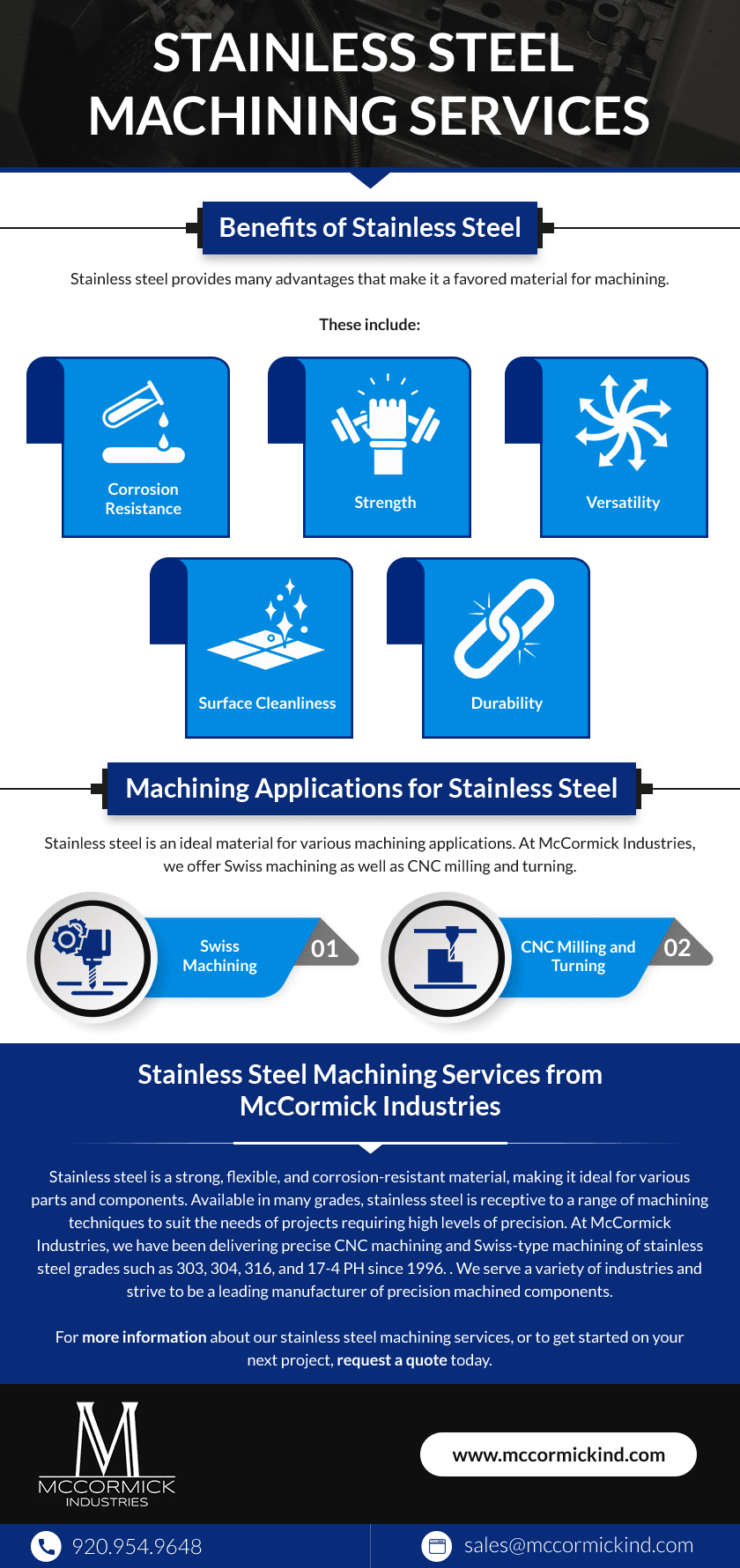
Machinability is the primary consideration when specifying a stainless alloy for a machined component. Free-machining grades like 303 stainless offer the best machinability in the stainless steel family because sulfur additions break chips cleanly and reduce cutting forces. However, 303 is not suitable for applications requiring welding or passivation to the most demanding ASTM standards. For those applications, 304 and 316 stainless are preferred.
Grade 316 stainless adds molybdenum to the alloy matrix, which improves resistance to pitting corrosion in chloride-rich environments. This makes 316 the go-to material for marine hardware, chemical processing components, and pharmaceutical equipment — all areas where our steel machining services are regularly specified. The downside is that 316 work-hardens more aggressively than 303 or 304, requiring sharper tooling, higher coolant pressure, and more conservative feed rates.
Precipitation-hardened grades such as 17-4 PH and 15-5 PH are frequently specified for aerospace and defense applications that need high tensile strength without the added weight of carbon steel. Our steel machining services for these materials use a staged approach: rough-machine in the annealed condition to remove the bulk of the material, then finish-machine after heat treatment to achieve final dimensions and tolerances. This sequence minimizes distortion and preserves the tight tolerances required in aerospace assemblies.
For customers who need machined stainless components but want to minimize cost, we offer material optimization reviews that evaluate whether a lower-cost grade can meet the service requirements. Substituting 304 for 316, for example, can reduce material costs by 15–25% when chloride exposure is not a concern.
Surface Finishing for Machined Stainless Steel Parts
Surface finishing is an integral part of custom stainless steel machining services because the post-machining treatment affects both appearance and functional performance. Passivation is the most common post-process for stainless steel machined parts. The passivation process removes free iron and other surface contaminants introduced during machining, allowing the chromium oxide passive layer to reform and restore the alloy's full corrosion resistance. Passivation is performed to ASTM A967 or AMS 2700 specifications depending on customer requirements.
Electropolishing is an electrochemical process that removes a thin surface layer to produce a mirror-bright finish and a further-enhanced passive layer that is more resistant to corrosion than a mechanically polished surface. This process is common in medical device manufacturing, where surface cleanliness and smoothness reduce bacterial adhesion. Our stainless steel machining services include coordination with qualified electropolishing vendors to deliver complete, inspection-ready assemblies.
Some applications call for a powder coat finish over stainless steel for color-coding, electrical isolation, or additional environmental protection. While stainless steel is inherently resistant to corrosion, powder coat adds a durable polymer barrier that can withstand abrasion, UV exposure, and mild chemical contact. Bead blasting or media blasting prior to powder coat ensures good adhesion.
Applications for Custom Stainless Steel Machining Services
Custom stainless steel machining services support a wide range of end-use industries. In aerospace and defense, stainless steel is used for fasteners, brackets, hydraulic manifolds, and structural fittings that must combine strength with corrosion resistance in demanding environments. Defense procurement often requires full material and process traceability, which our documentation practices support natively.
Medical device manufacturing relies on stainless steel for surgical instruments, implant components, and sterilizable housings. The biocompatibility of implant-grade 316L and the ability to achieve sub-micron surface finishes make stainless the preferred material for many Class II and Class III device applications. Our precision stainless steel machining services include the cleanroom-compatible handling and packaging practices required for medical device components.
Consumer electronics enclosures, robotics end-effectors, and automation components are increasingly specified in stainless steel when plastic enclosures cannot meet strength or EMI-shielding requirements. We machine stainless steel parts for these sectors at competitive cycle times by leveraging high-speed machining strategies and automated part-loading systems that reduce per-piece labor cost.
Industrial pump and valve bodies, fittings, and manifolds represent another core application for our stainless steel machining services. These components must maintain leak-free dimensional integrity across wide temperature and pressure ranges, often in chemically aggressive process streams. Our team is experienced in the seal pocket and port geometries common to these components and maintains process capability data to support statistical process control requirements.
Machining Stainless Steel vs. Other Materials
Machining stainless steel requires different tooling and process strategies than machining aluminum, plastic, or engineering polymers such as polypropylene. Aluminum cuts at much higher surface speeds with longer tool life; polypropylene and similar thermoplastics require very sharp edges and careful heat management to prevent melting or built-up edge formation. Stainless steel sits in a different performance envelope: lower cutting speeds, higher torque demands, greater tool wear rates, and a stronger tendency to produce long, stringy chips that must be managed to prevent nest formation around the tool and workpiece.
For customers transitioning a component from plastic or aluminum to stainless steel, we offer cost modeling that accounts for the higher material cost, longer cycle time, and additional finishing steps. In many cases, moving to stainless steel reduces total lifecycle cost by eliminating replacement cycles driven by corrosion, wear, or dimensional instability of the original material.
Quality, Lead Time, and Capacity for Steel Machining Services
Our steel machining services operate under an ISO 9001-certified quality management system. All measuring equipment is calibrated on a defined schedule, non-conformances are tracked and root-caused, and corrective actions are verified for effectiveness before closure. This system gives customers confidence that the controls governing their parts are consistent across production runs, whether they order 10 pieces or 10,000.
Lead times for stainless steel parts machining services vary by complexity, tolerance, and volume. Simple turned parts from in-stock material can ship in days. Complex multi-operation milled components with tight tolerances and downstream finishing typically require two to four weeks from purchase order to ship. We maintain stocked inventory of the most common stainless alloys — 303, 304, 316, 316L, 17-4 PH — to support fast turnaround without premium material surcharges.
Capacity planning for long-term programs is supported by blanket order agreements that lock in pricing, reserve machine time, and establish a release schedule matched to the customer's consumption rate. This arrangement is common for customers in aerospace and medical who need predictable supply without carrying large on-hand inventories of machined stainless steel components.